
Tutorials · 21 September 2026 · 7 min read
Why Magnum Builds on Polysilazane, Graphene Oxide and Amorphous Boron
Most coatings are sold on the number. 10H. 120 degree contact angle. Five years.
Very few are sold on what's actually in the bottle and why. That's the part that decides whether the number still means anything in two years.
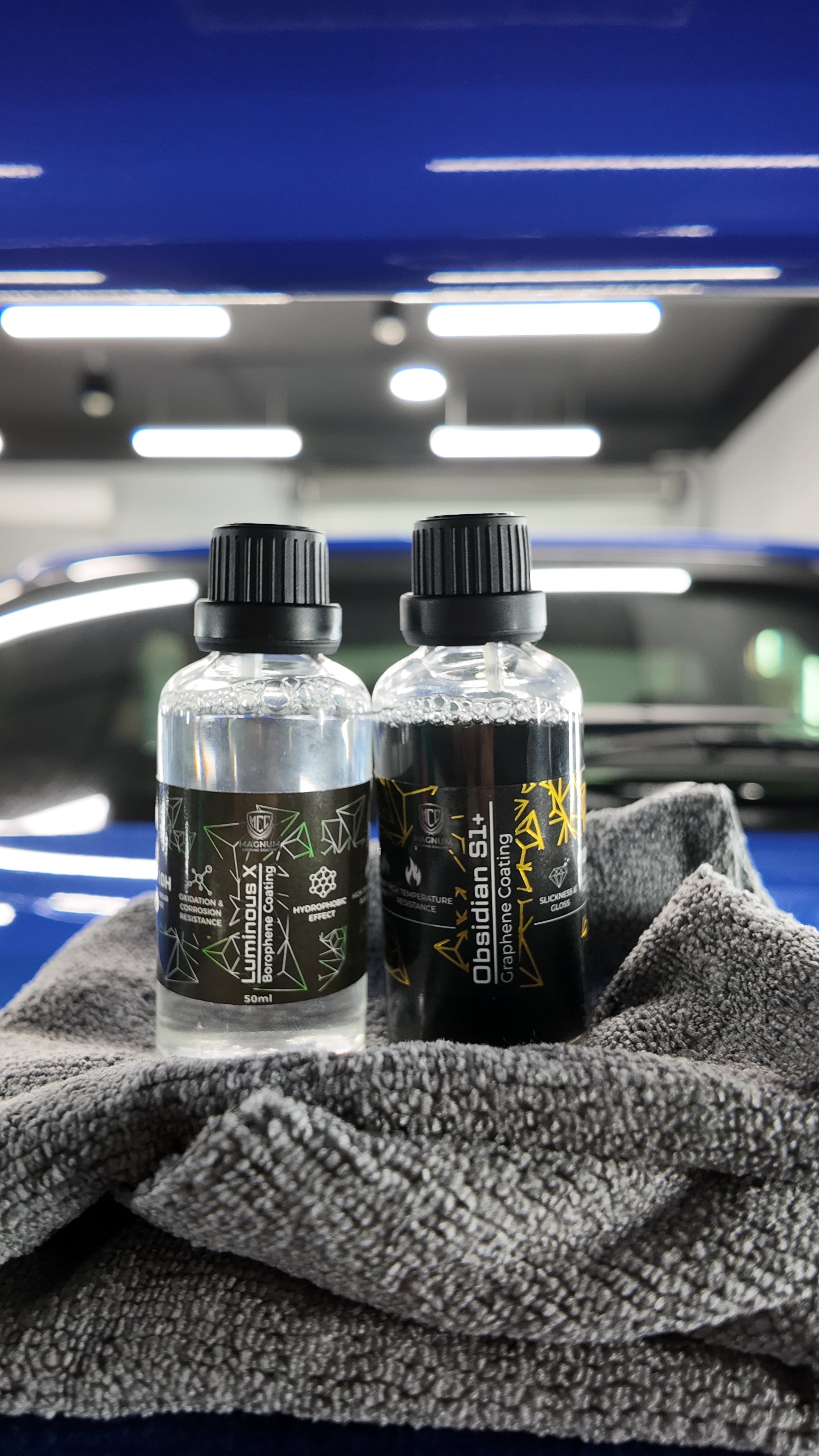
Magnum runs on three raw materials working together. Here's the reasoning behind each one.
Polysilazane is the base, and that's a deliberate choice
Most of the market is built on silica, siloxane or silane chemistry. Polysilazane is a different class. It converts into a true glass network as it cures rather than depositing a resin layer on the paint.
The upside is a harder, denser, more chemically resistant film. The downside is that polysilazane is difficult to work with. It shrinks as it converts, it's sensitive during cure, and a poorly formulated one will crack or cure incompletely.
That's exactly why the other two materials are there. Neither is a bolt on. Both solve real problems in the base chemistry while adding performance of their own.
Amorphous boron: getting the cure right
Boron does something most additives don't. It actively changes how the coating cures.
It accelerates the linking reaction, so the glass network forms tighter and more completely at room temperature. No heat lamps, no booth. A film that reaches its real properties instead of sitting half finished.
It also relieves the internal stress caused by shrinkage. That's what lets you build genuine thickness in a pass without hairline cracking at panel edges, and cracks are where coating failure starts.
On top of that it raises thermal stability, which matters on wheels, near exhausts, and on dark paint parked in an Australian summer. And boron is a hard material in its own right, so at nano scale it reinforces the film directly as well.
What the customer sees: harder surface, deeper gloss from a flatter and less porous film, and a mitt that glides instead of drags.
Boron: what it actually does for coating performance
Performance
Boron accelerates and completes the cure, so the glass network forms tighter with fewer gaps. The film reaches its real properties instead of sitting half finished. Harder surface, better swirl resistance, and it tolerates heat that would start degrading a straight polysilazane film. Wheels, exhaust areas, dark paint in summer.
Gloss
Denser network with less cure shrinkage means fewer micro voids and fewer stress defects at the surface. Flatter film, so light reflects in one direction instead of scattering. Deeper reflections, sharper edges, and no hazing as the film ages because it isn't going porous.
Slickness
Same flatness, felt instead of seen. Less microscopic texture for a mitt or a towel to catch on. The mitt glides, marring during maintenance washes drops, and contamination releases with less pressure because dirt sits on top rather than keying into pores.
Hydrophobics
Boron doesn't create the beading. Beading and sheeting come from the surface chemistry and its surface energy. What boron does is build the dense, flat, non porous substrate underneath that lets that chemistry perform properly and keep performing. Water sheets cleaner off a flat surface because there's less to interrupt the flow.
Water contact angle
Peak contact angle is set by the functional chemistry, not by boron. Where boron matters is the number twelve months out. A porous, degrading film loses contact angle fast. A dense, chemically resistant, thermally stable one holds it. Boron protects the retention, not the starting figure.
Durability
This is where boron earns its place.
Denser film means less permeability, so bird etch, bug acid and industrial fallout have fewer gaps to work into.
Reduced shrinkage means you can build thickness without hairline cracking at panel edges, and cracks are where failure starts.
Higher thermal stability means the film doesn't break down early on hot panels and wheels.
Complete cure means the film isn't slowly degrading from a weak starting point.
Graphene oxide: reinforcement and barrier
Graphene oxide carries oxygen groups that bond straight into the polysilazane network as it cures. It isn't filler suspended in the film. It becomes part of the structure.
The sheets are two dimensional, so they lie flat and spread load across a wide area rather than concentrating it at a point. Abrasion and impact get distributed instead of driven into one spot.
They also work as a physical barrier. Water, salt and contaminants have to travel around the sheets rather than straight through the film, which slows permeation dramatically. And thermal conductivity across the sheet plane helps move heat sideways rather than letting it pool on a hot bonnet.
What the customer sees: scratch resistance that comes from structure rather than surface hardness alone, and a coating that holds its performance through years of weather and washing.
Performance
Graphene oxide carries oxygen groups on its edges and surface that bond straight into the polysilazane network as it cures. It isn't filler sitting in the film, it's part of the structure. Those sheets are two dimensional, so they lie flat and spread load across a wide area instead of concentrating it at a point. Impact and abrasion get distributed rather than driven into one spot.
Gloss
At true nano scale and properly dispersed, the sheets sit below the wavelength of visible light, so they reinforce without scattering it. The film stays optically clear and flat. Graphene also darkens the film slightly at depth, which reads on dark paint as more depth in the reflection rather than added colour.
Get the dispersion wrong and it goes the other way. Oversized or clumped particles scatter light, haze the film and kill the gloss you corrected for.
Slickness
Sheet geometry is the point here. Flat platelets tile across the surface and fill in what would otherwise be micro texture. Less for a mitt to catch on, less mechanical grab during a wash.
Hydrophobics
Graphene oxide on its own is hydrophilic. The oxygen groups that make it bond so well into the matrix also attract water. It is not the thing making your panel bead.
What it does is reinforce and seal the film so the surface chemistry that does produce the beading has a dense, intact substrate to sit on. Water sheets faster off a flatter surface, and sheeting behaviour is where the sheet structure genuinely helps.
Water contact angle
Same as boron. The starting number comes from the functional chemistry. Graphene oxide protects how long that number holds, because a reinforced film resists the wear and micro damage that drags contact angle down over months.
Durability
This is the real argument for graphene in a coating.
Sheets act as a physical barrier layer. Water, salt and contaminants have to travel around them rather than straight through, so permeation slows right down.
Load spreading means less micro cracking under thermal cycling and mechanical stress.
Thermal conductivity across the sheet plane helps move heat sideways instead of letting it pool, which matters on dark panels and bonnets.
Reinforced film means scratch resistance that comes from structure, not just from surface hardness.
The part most brands won't say
Neither graphene nor boron makes water bead.
Beading and sheeting come from the surface chemistry and its surface energy. That's a separate part of the formulation and it's the same reason a cheap coating can post a great contact angle on day one.
Peak contact angle is easy. Holding it is not.
A porous, poorly cured, thermally unstable film loses contact angle fast. A dense, reinforced, chemically resistant one holds it. That's the entire job boron and graphene do. They don't create the performance you see in month one. They make sure it's still there in year two.
Same with gloss and slickness. Both are just microscopic flatness, seen and felt. Keep the film dense and flat and both survive. Let it go porous and both fade, regardless of how good the coating looked when it flashed off.
Why dispersion decides all of it
None of this works if the particles are too big.
Oversized graphene can't fit into the crystal matrix of the coating. It clumps, stops the film curing cohesively, hazes the gloss, and behaves like micro sandpaper under an applicator pad. Boron has a narrow loading window before it tints the film or brings dispersion problems of its own.
So the raw materials are only half the story. Processing them to true nano scale and holding them in uniform suspension is the other half, and it's where most graphene claims on the market fall apart.
In Summary:
Polysilazane gives us a glass network instead of a resin layer.
Boron makes that network form tighter, faster and without cracking.
Graphene reinforces it and seals it against what the road throws at it.
Together they don't chase a first week number. They build a film that still measures well after many Australian summers.
Keep reading
More from the lab


Most coatings focus on gloss