
Tutorials · 15 January 2026 · 3 min read
The Two Types of Slickness in Ceramic Coatings — and Why Only One Lasts
Explanation of Different Smoothness Performance Mechanisms
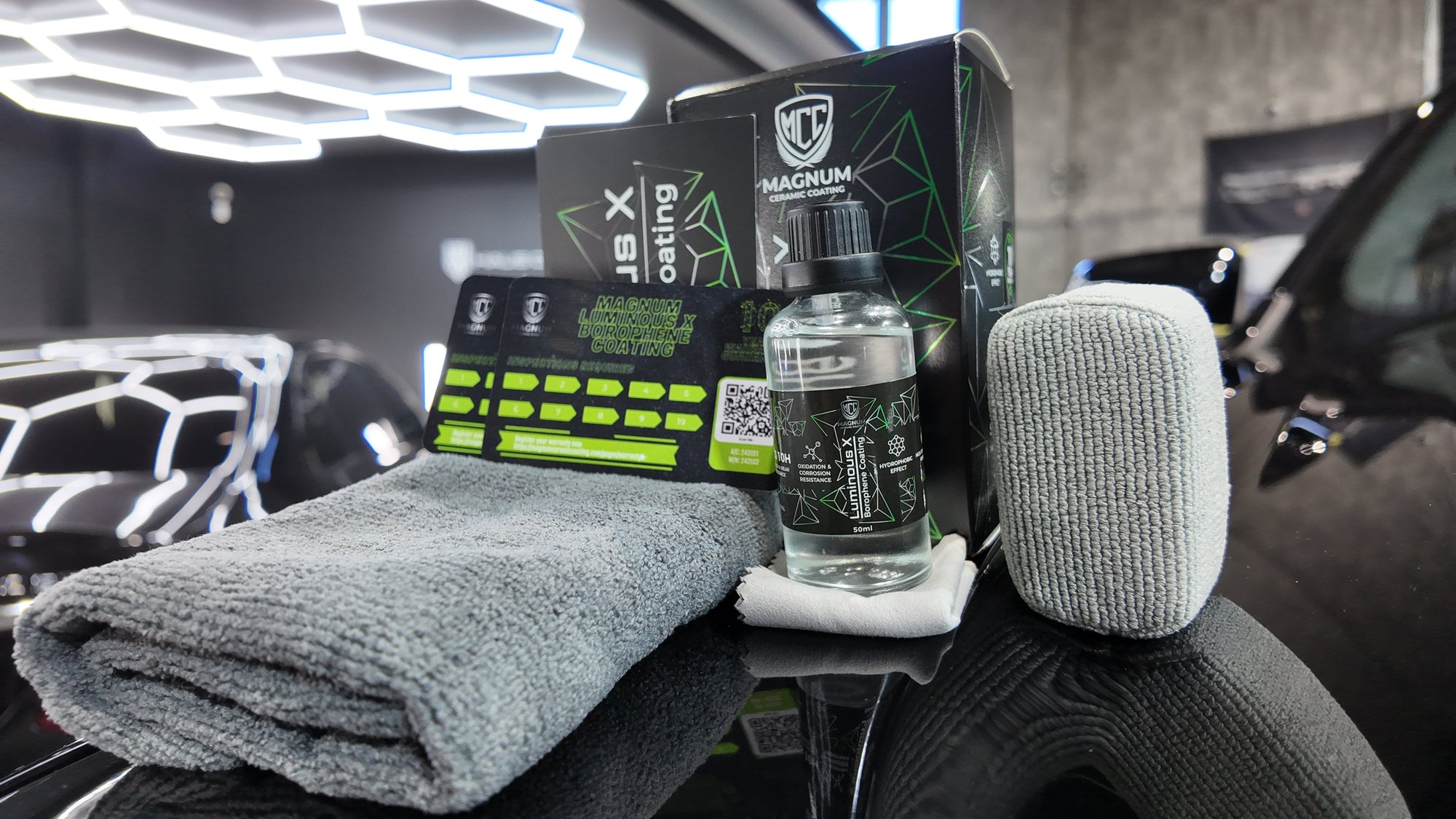
Our Luminous X and Obsidian S1+ achieves “slickness” through two completely different technical routes. The difference is when and how slickness appears is mainly caused by formulation design and the coatings curing process.

Our Product: Structural Smoothness from High-Resin Film Formation
Our product is designed around a high resin loading, which is a high concentration of resin forming a dense, hard, and highly levelled layer after curing.
This film has:
- High surface flatness
- Low surface friction
- High hardness
Because of this, the slickness comes from the structure of the cured coating itself, not from oily substances on the surface. This is what we call structural smoothness.
Why do we focus on high resin content?
- High concentration of resin = high hardness
- High hardness = strong abrasion resistance and wash resistance
Only a hard and dense glass resin structure can maintain long-term performance
Therefore:
Right after application, the coating has not fully cured therefore, slickness is limited.
As curing progresses:
- Resin molecules crosslink and organize
- The film becomes harder, denser, and flatter
- Smoothness continuously increases
After about 3 days, curing is basically complete. Slickness reaches its peak and becomes stable.
So the slickness derived from our products are highly dependent on resin curing and the glass resin layer formation.
Whats out there in the market: Instant Smoothness from High Oil Additives
The competitor mainly relies on a high concentration of oily or lubricating additives, such as:
- Silicone oils
- Waxes
- Low-molecular lubricants
These materials:
- Move quickly to the surface right after application
- Form an “oil-rich surface layer” that feels very smooth immediately
Because this smoothness comes from surface oils, it:
- Does not rely on resin curing
- Appears instantly after application
However, this kind of slickness is:
- Easily reduced by washing
- Easily affected by sunlight and heat
- Gradually lost as oils evaporate, degrade, or are worn off
So the competitor’s smoothness is mainly a temporary surface-oil slickness, not a structural one.

Key Difference in our design philosophy
Our products:
- Uses a glass resin structures to create slickness
- Depends on resin curing
- Focuses on durability and long-term performance
Competitor products:
- Uses surface oils to create smoothness
- Does not depend on curing
- Focuses on instant hand-feel
|
|
Luminous X and Obsidian S1+ |
Competitor Products |
|
Main mechanism |
Structural slickness from cured resin film |
Surface slickness from oil additives |
|
Key ingredients |
High resin content |
High oil / lubricant additives |
|
Smoothness appearance time |
Gradually increases with curing |
Immediate after application |
|
Dependence on curing |
Highly dependent |
Almost not dependent |
|
Film hardness |
High |
Relatively low |
|
Scratch resistance |
Strong |
Limited |
|
Wash resistance |
Strong |
Weak – oils wash off |
|
Sun / heat resistance |
Stable |
Oils degrade or evaporate |
|
Long-term smoothness |
Stable and durable |
Quickly declines |
|
Product philosophy |
Performance and durability |
Instant hand-feel |
Summary
We build slickness through a high-resin, high-hardness, high-flatness film structure, so the surface becomes smoother as curing completes and stays smooth for a long time.
Competitor products mainly rely on surface oils.
They feel very smooth at first, but this effect fades quickly after washing and sun exposure.
We focus on durability: high resin, high hardness, and smoothness that comes from structure and curing.
So:
- Competitor products that take the other route achieve slickness fast but short-lived
- Our products achieve slickness slower, but are long-lasting
Short-term attraction is easy.
Long-term satisfaction creates a real win-win scenario for coatings.

Keep reading
More from the lab


Most coatings focus on gloss