
Tutorials · 07 February 2026 · 3 min read
Solvent Borne Silicone Resin Coatings vs Ceramic Conversion Coatings
Why Cross-Linking and Substrate Bonding Matter More Than Just Gloss and Slickness
The term ceramic coating has become a catch-all in the automotive detailing world. From professional installer products to consumer sprays, many coatings carry the same label, yet behave very differently over time.
At a formulation level, most ceramic coatings fall into two distinct technologies:
-
Ceramic conversion coatings
-
Solvent-borne silicone resin coatings
Both aim to protect paint.
Only one is engineered to bond, cross-link, and become part of the surface itself.

Two Formulation Paths, One Name
1. Solvent-Borne Silicone Resin Coatings (Most Common)
These coatings rely on:
-
Silicone resins and polymers
-
High solvent content to carry the formula
-
Film formation as solvents evaporate
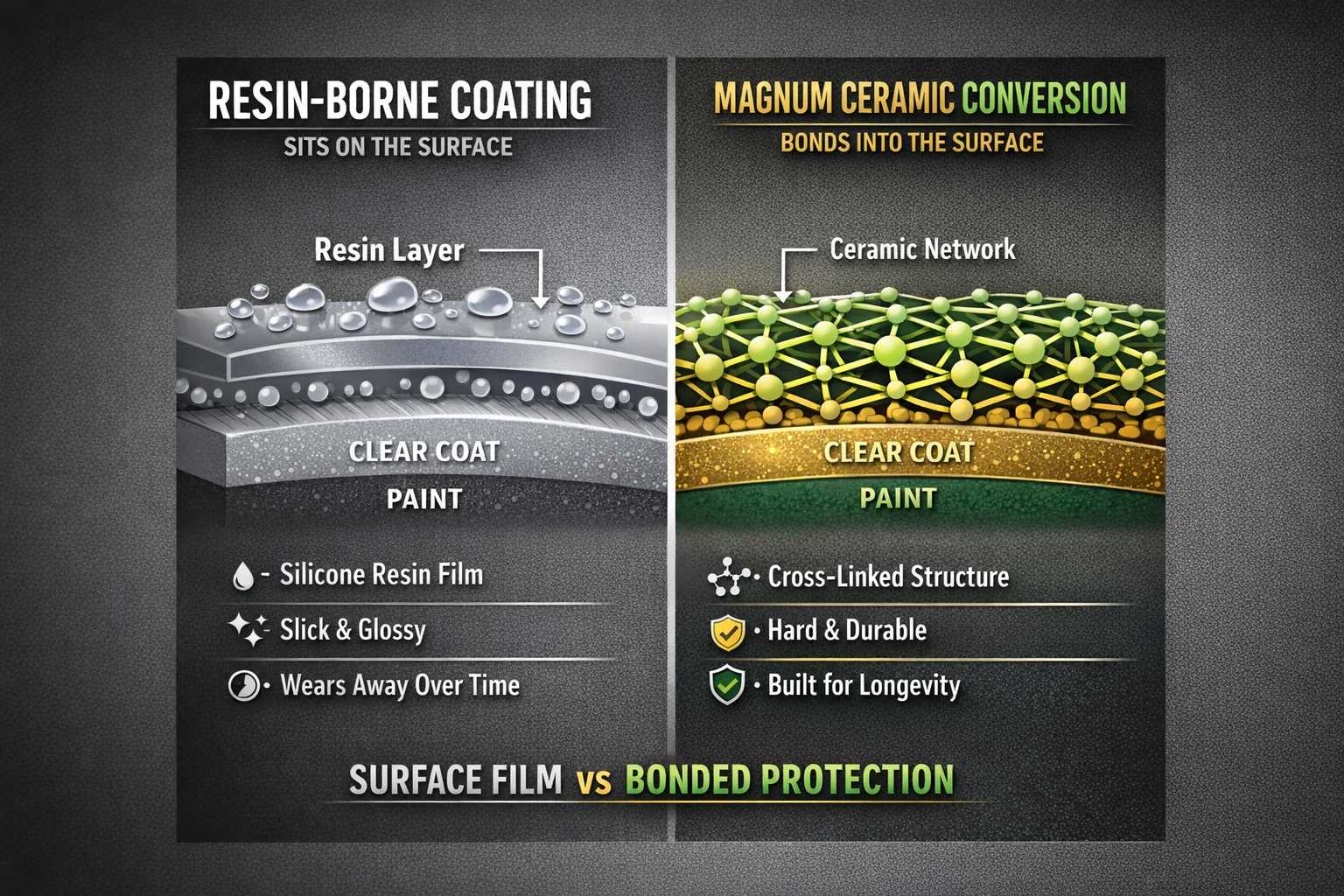
Once applied, the solvents flash off and leave behind a thin resin layer sitting on top of the clear coat.
This approach dominates the market because it offers:
-
Easy application
-
Fast wipe-off
-
Immediate gloss and slickness
-
Strong initial water beading
However, protection is governed by how long that surface film remains intact.
2. Ceramic Conversion Coatings (Less Common, More Technical)
Ceramic conversion coatings are built around:
-
Silazane chemistry
-
Silica-based structures
-
Reactive silanes that chemically bond to the substrate
Instead of simply drying, these coatings undergo a chemical conversion during curing.
Their molecules react, cross-link, and transform into a ceramic-like network that anchors directly to the surface.
This approach prioritises:
-
Chemical bonding
-
Structural stability
-
Long-term performance over cosmetic immediacy
What Does “Cross-Linking” Actually Mean?
Cross-linking is one of the most misunderstood yet critical concepts in coatings.
In simple terms:
Cross-linking is the process where individual molecules chemically connect to form a stable, interconnected network.
Why this matters:
-
Cross-linked structures are harder to break apart
-
They resist chemicals, heat, and abrasion more effectively
-
Performance is built into the structure, not dependent on surface oils or resins
In ceramic conversion coatings, cross-linking occurs during curing, creating a dense Si–N–Si (silicon-nitrogen-silicon) lattice that behaves more like a ceramic than a polymer film.
This is fundamentally different from silicone resin systems, where most cross-linking happens within the resin itself, not between the coating and the paint.

Bonded vs Surface-Level Protection
Ceramic Conversion Coatings
-
Chemically bond to the clear coat
-
Cross-link into a rigid, stable network
-
Become part of the surface at a molecular level
-
Maintain performance as the coating ages
Silicone Resin Coatings
-
Sit on top of the surface
-
Rely on physical adhesion and resin integrity
-
Gradually wear away under washing, heat, and abrasion
- Typically contain silicone oils and molecular lubricants at the surface level
-
Often lose slickness and hydrophobic behaviour over time
Both approaches protect but they do so in very different ways.

Tell-Tale Signs During Application
Chemistry reveals itself in how a coating behaves.
Silicone Resin Coatings Often Show:
-
Extremely slick feel immediately after application
-
Very fast wipe-on and wipe-off
-
Strong solvent smell
-
Instant gloss “pop”
-
Gradual decline in slickness as the film wears
Ceramic Conversion Coatings Often Show:
-
Slight grab or resistance during initial curing
-
Less oily or silicone-like surface feel
-
Progressive hardening over time
-
More stable performance weeks and months later
These characteristics areclues to how the coating is engineered.

Why Ceramic Conversion Is Built for Longevity
Because ceramic conversion coatings:
-
Bond chemically to the substrate
-
Cross-link into a dense ceramic matrix
-
Are reinforced by inorganic structures like silica
They are inherently:
-
More resistant to chemicals
-
More stable under heat cycling
-
Less reliant on surface slickness for perceived performance
-
Better suited to long-term protection goals
This is why they’re often favoured in environments where durability matters more than immediate visual impact.
Choosing the Right Coating Comes Down to Priorities
There’s no universal “best” coating — only the best choice for a given objective.
-
If instant gloss, slickness, and ease of use are the priority, surface-film resin systems excel.
-
If bonded protection, structural durability, and long-term stability are the priority, ceramic conversion coatings are engineered for that role.
Understanding the chemistry allows installers and consumers alike to set realistic expectations and avoid disappointment later.
Keep reading
More from the lab


Most coatings focus on gloss